
The doomcasting approach to decision making
Why your fear of the worst case scenario is delaying your decisions, and how embracing it can get you past the block.

I’ve spent the vast majority of my career as a consultant and coach helping people make decisions. Whether it’s about their positioning, messaging, marketing, offers, or even just general decisions about the direction of their business. And over the years I began to notice something interesting… that right as they were about to make the call and head past the point of no return, they well, wouldn’t.
And this was frustrating to me. My job wasn’t to make the decision for them. My job was to advise. To help them make sure they understood the implications of any decision, to challenge their thinking, show them their blindspots and biases. But actually making the decision and acting on it? That was all on them.
Naturally, them not making the decision after all that work was annoying. And so I wanted to figure out why it kept happening. So I did some digging and found that this is a real, documented phenomenon. Psychologists call this the “intention-behaviour gap”. (Occasionally “intention-action” is used as well.)
Why the intention-behaviour gap exists
Consider a meta-analysis conducted by Rhodes and de Bruijn in 2013 [1] which found that across several studies that gap was 46%. In other words, in studies looking at how intention influences behaviour (in this case concerning exercise and fitness) about half of the people did NOT do what they intended to do. They made a decision, but they didn’t act on it.
Making a decision but not acting on it is essentially equivalent to not making the decision in the first place. And it occurred to me that this is effectively what was happening with my clients. They made the call in the room with me, they intended to act on that call, but when push came to shove they stopped and did nothing. They delayed the decision.
So why does this happen? Scientists have proposed several factors that contribute to the gap. One is a lack of motivation. If you feel like you “should” do something rather than you “want” to do something, then you’re less likely to actually do it. Another is vagueness. Without a concrete, tangible plan of what you’re going to do, when you’re going to do it, and how you’re going to do it, then even the best intentions fall short.
But with my clients, I felt there was something else going on. And it dawned on me that the real reason for this indecision wasn’t a lack of motivation (clearly they wanted to do this work) or a lack of plan (we came up with that in our sessions) but a fear. More specifically, a fear of the unknown.
Decisions are inherently scary
If you knew with 100% certainty the outcome of a decision, you wouldn’t really have much of a decision to make. If your goal was to triple your revenue, and you knew with absolute certainty that pushing a button would do exactly that, then you wouldn’t have to decide whether or not to push it. You’d just push it.
But most business decisions are not certain. Far from it, in fact. Most business decisions are so complex with so many potential consequences that trying to calculate the exact call to make is impossible. But that’s exactly what we try to do. It’s exactly what my clients were trying to do. Collect more data, gather more opinions, seek permission. Constantly batting away the actual decision-making in favour of doing their due diligence. Now, I’m not saying due diligence is bad. You should absolutely do some. But there comes a point where you’ve done all you can, and the only thing left to do is make the call.
And this is where most decision-making breaks down and stalls. Not because we don’t know what decision to make, but because we’re scared to make it. We’re scared of getting it wrong. Scared of it all blowing up in our face. To use the example from earlier, what if pushing that triple-revenue button also comes with a slight chance of halving our revenue? Now we’re going to be a lot more hesitant when it comes to pushing it.
When I realised this was holding my clients (and myself!) back from making the tough decisions, I instantly understood the solution. You have to embrace the worst case scenario.
Embracing the worst case scenario
Most people are familiar with the role visualisation plays in elite sportspeople. But chances are you’ll only think of the positive version. Imagine yourself running the perfect race or hitting the perfect serve over and over, and you’re more likely to achieve it. That’s the version most of us think of. But there’s also growing evidence that visualising the worst outcomes helps too.
In 2008, Michael Phelps was dominating swimming pools around the world. Arguably the greatest swimmer of all time, he readied himself ahead of the 200m Butterfly final. As he dived in, his goggles cracked and started to fill with water. A nightmare scenario. One of the worst things that could happen. But Phelps was able to not only deal with this setback, but go on to win gold and break the world record in the process.
His coach, Bob Bowman, was the reason. Bowman had Phelps visualise not just the perfect series of events, but the worst ones too. At Bowman’s insistence, Phelps had imagined the exact scenario of his goggles breaking. This helped him in two ways. Firstly, it helped him quickly deal with it as it unfolded. He knew what was happening, knew how to fix it, and could just act. Secondly, it helped him go into the race more prepared. And when you’re more prepared you’re more confident.
When it comes to making a big decision, you’re ultimately choosing an uncertain path. Visualising the worst case scenario helps to build your confidence. And it turns out there’s precedent for this in therapy.
Decatastrophising is an annoyingly long word coined by Albert Ellis, one of the godfathers of the now-commonplace cognitive behavioural therapy (or CBT). The idea was that rather than seeing the worst case scenario as something to be avoided at all costs, you would confront it head on, asking what it would look like if the worst happened, what the consequences would be, and hopefully realising that you’re more than capable of dealing with it should it happen.
Much like Bowman’s advice to Phelps, one of the most effective ways of overcoming your fear of the worst case scenario is to embrace it. Which brings us to doomcasting.
Introducing the doomcasting approach
Doomcasting is my own approach to bridging the decision-action gap. It invites you to imagine if your chosen decision is actually wrong, and the worst case scenario happens as a result. This helps in several ways, but the easiest way to explain how is to walk you through the framework step by step.
There are four steps in the doomcasting sequence: Description, Odds, Outline, Management. You might notice those four steps spell out DOOM. That took a lot of work on my part.
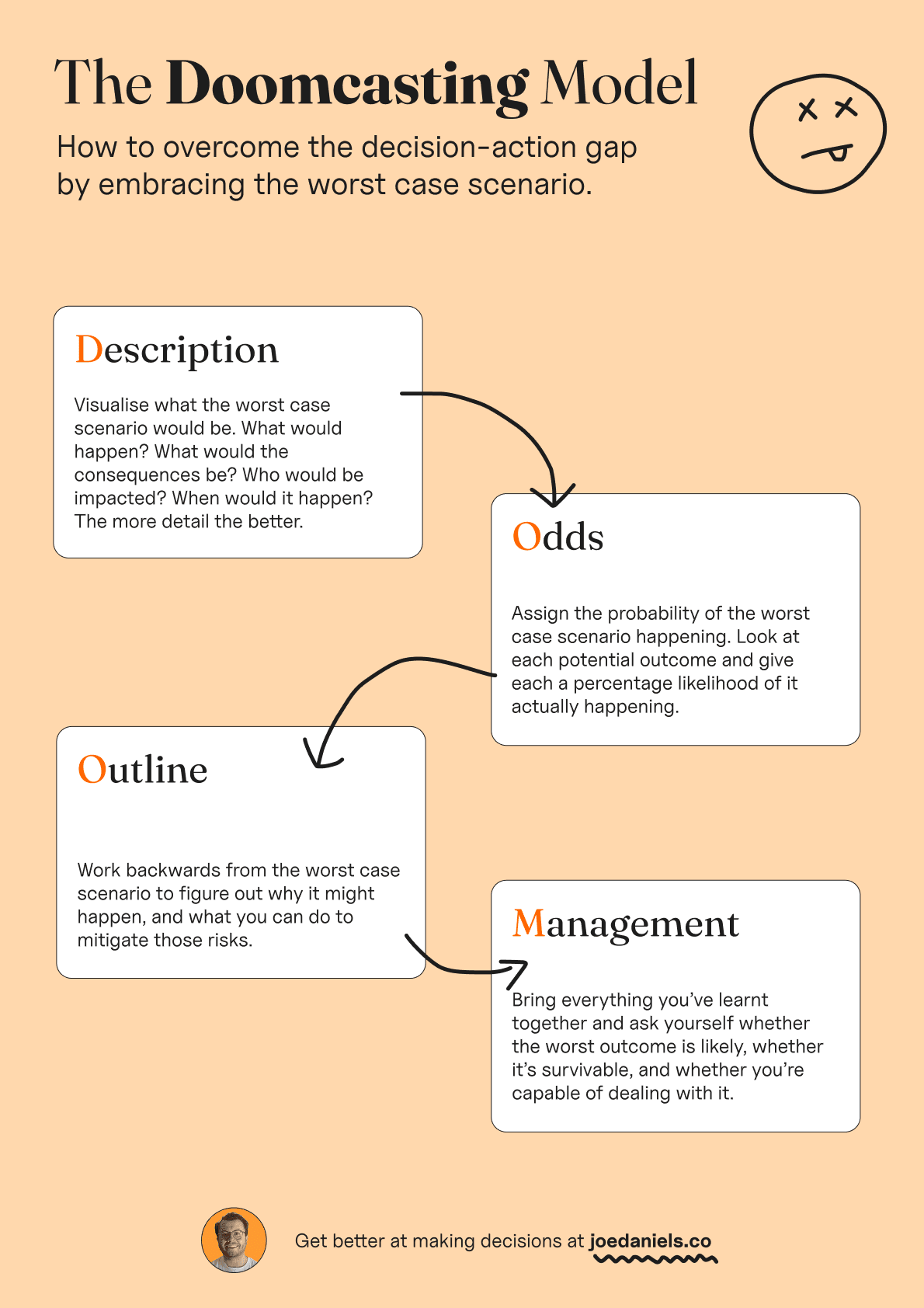
Let’s take it step by step.
Description involves you literally describing what the worst case scenario would be. What would happen? What would the consequences be? Who would be impacted? When would it happen? The more detail the better.
This helps because research shows that a vague sense of dread is far scarier than a concrete knowledge of what you’re scared of. Stating the fear strips it of some of its power.
Odds is where you assign a probability of the worst case scenario happening. Looking at each potential outcome and assigning each a percentage likelihood.
This helps because studies show that we often overestimate the likelihood of negative consequences compared to positive. Seeing that the worst case scenario is relatively unlikely helps to alleviate some of the fear. (Note that if you do this step and decide that the worst outcome is actually pretty likely, then perhaps you aren’t making the wisest decision.)
Outline is where you work backwards from the worst case scenario to figure out why it might happen, and what you can do to mitigate those risks.
This is an adaptation of Klein’s “pre-mortem” concept. Imagining why something might go wrong so you can avoid those missteps. Much like Phelps and his goggles, it prepares you on what to look out for and what to do in that moment.
Management is where you bring everything you’ve learnt together and ask yourself whether the worst outcome is likely, whether it’s survivable, and whether you’re capable of dealing with it.
This helps you tackle your fear head on and hopefully helps you realise that the worst case scenario isn’t as big a threat as it initially seemed and put you in the right frame of mind to finalise your decision and act on it.
Next time you’re feeling like you’re going round in circles and delaying a decision, ask yourself why. I’m willing to bet it’s because you’re scared of the worst case scenario happening. In which case doomcasting should help you overcome that fear.
If you’re interested in learning more about how to use my doomcasting technique, it forms a large part of my cohort training. Why not come along and learn it?
References: